
Tech and Gear
Currency
Every place you go in Afterverse will take some sort of currency. This currency varies depending on the time and place, but more specifically, it varies depending on the Culture. Each Culture in a particular Era will have as one of its Attributes a Base Income; whatever currency in which this Base Income is listed is the main exchange medium of that Culture.
Exchange Rates
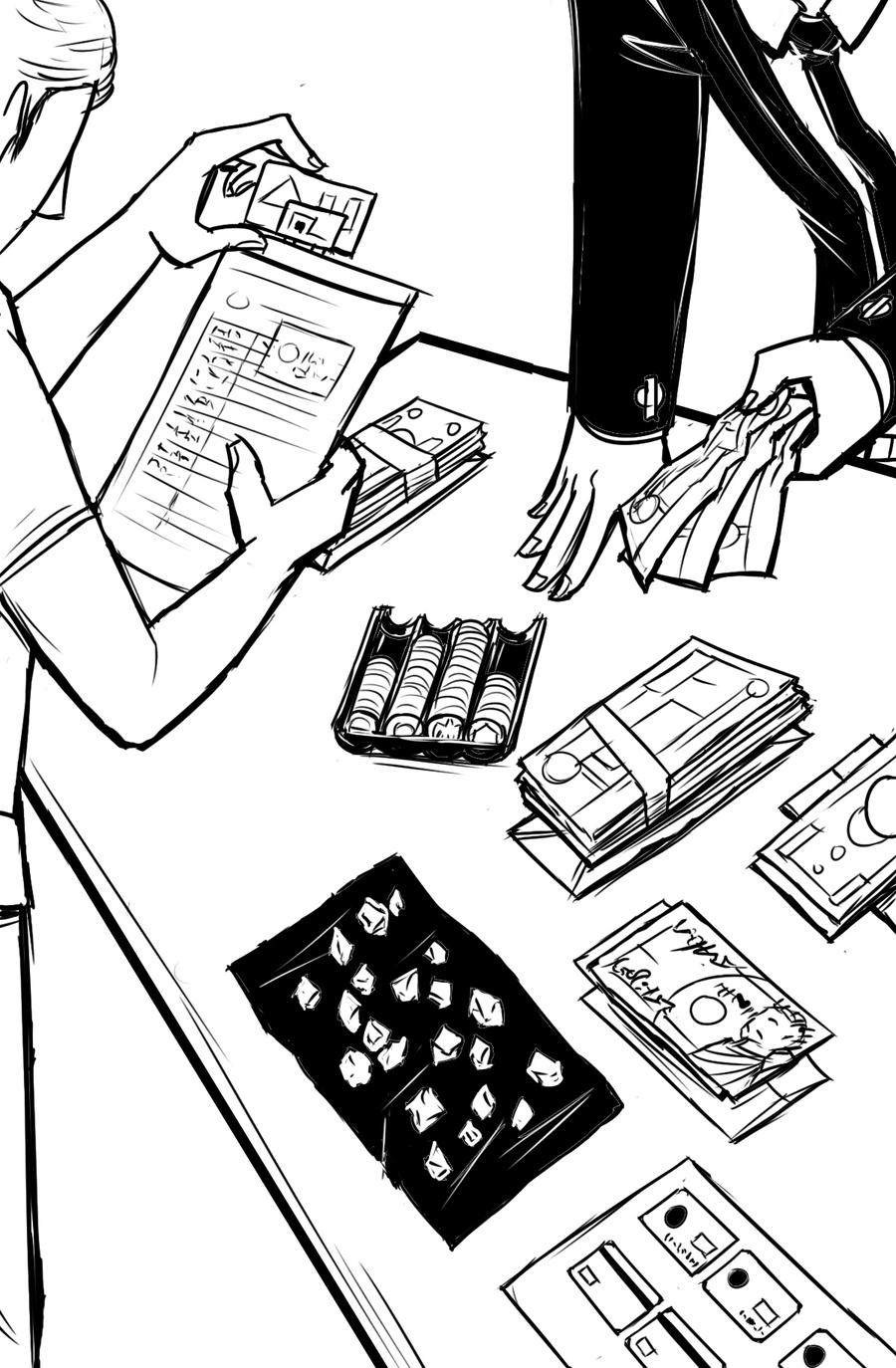
Currencies can sometimes be exchanged for others in most situations. Cultures that live near or trade with other Cultures will be able to exchange their respective currencies. Currencies can only reliably be exchanged at banks and similar official establishments, but less official means of exchange may exist as well—for a fee. However, if for example the feds are on the lookout for mercenaries they know have been paid with a large sum of an unusual currency, it might be wise not to trust the banks with that particular sum.
Exchange rates are not explicitly listed, and should be inferred from context based on Cultures and Costs. As a GM, when players exchange money, do not worry about providing a precise or fair exchange rate to your players; offer them whatever amount of money you think they should have.
Items
Item Variants
Many items are available in most if not all Cultures. Just because the same generic item is available in multiple Cultures, however, doesn't necessarily mean they are the same thing, and in fact may serve different uses. The uses will be similar enough that these items will be grouped together. For example, a First Aid Kit for Humans and a First Aid Kit for Bactarans contain few of the same basic components, and cannot be used interchangeably on both species. However, they do serve mostly the same function, follow the same rules, and cost about the same.
For this reason, many items list Variants. Some of these Variants are explicitly listed (for example, Climbing Gear lists "Rappelling" and "Climbing" separately), but, more often, the Variants available are something like "per Culture" or "per Species." In those cases, the purchased item is only useful in that context. If an item does not have variants specified, it can be assumed that items of that type are similar enough across the board that they may be used interchangeably.
Knowing where someone's gear came from can be important in many situations. If a Culture is known, then its generic items can usually be recognized. Depending on the item type and situation, either an Interest test, a PER + Science (Forensics) test may be required to notice and/or recognize the distinguishing details.
Item Rating
Some items have different Ratings available. The effect of the Rating is generally elaborated in the item's description or other stats. In all cases, different Ratings of an item should be treated much like different Variants. If the item's Tech Level requirements, Rarity, or Cost incorporates the Rating (Rtg) of the item, then that Attribute is calculated using any chosen Rating. For example, a Radiation Suit has a minimum MFR TL of 2 + Rtg / 2, and provides + Rtg to RAD protection. Therefore, a Rating 2 Radiation Suit requires MFR TL 3 and provides RAD + 2; a Rating 4 Radiation Suit requires MFR TL 4 and provides RAD + 4. These Variants are treated as two different items.
Cost
The Cost of items is given without any unit or currency. This is because these items may be available in any currency, and the exact Cost may be different in each currency. When determining the value of a generic item in a particular Culture, multiply the Base Cost of that Culture by the Cost of the item, and use its currency.
Item Attributes
Min TLs : The minimum required Tech Level(s) for a Culture to have this item available.
Rarity : How Rare the item is, when it is available. See the "Rarity" section on the online edition for more details.
Size Classes/Cost : The Size Classes for which this item is available, and the Cost for each. In the case of weapons, a character can generally only use weapons up to their own Size Class. They may use one Size Class higher if they use the Heavy Weapons Specialization, with some caveats; see the "Size Classes" and "Weapons" sections in the "Combat" chapter on Combat for more details.
Weapon Attributes
Design : The design elegance of the weapon adds a dice pool bonus, and has implications with regard to weapon maintenance. See the "Design Attribute & Weapon Maintenance" section on the online edition.
Reach : Because most Melee attacks include a movement Action, Reach largely affects the weapon's defensive usefulness. See the "Reach in Combat" section on Combat.
DV/Splash : The Damage Value is a code representing how much damage a weapon does to its target, and to others near its target. See the "Damage," "Damage Codes," and "Healing" sections in the "Combat" chapter on Combat.
Auto : How many rounds this weapon can fire in a single Fire Action. See the "Automatic Weapons" section on the online edition.
V/A (Vacuum/Atmosphere): Some weapons may be operated in atmosphere, depending on the gas for their effects; others may only be operated in vacuum, for similar reasons. Most weapons work in both.
Armor Attributes
Armor : The Armor Value of the item. These values, generally speaking, cannot "stack" with more Armor; you can't simply pile Armor on top of Armor. If wearing multiple items, use the highest single value.
EPR : The Environmental Protection Rating of a suit describes its effect on the character's environmental tolerances. See "Environmental Protection" on the online edition for more details.
Rarity & Availability Tests
Some items have a Rarity Attribute that determines the difficulty of acquiring the item. If an item does not have this Attribute listed, it can generally be obtained by walking into nearly any store and buying it. If it has such a Rating, then the character will need to roll a MAN + Influence (Bargaining) test. The number of hits rolled is the maximum Rarity item that she can find on her own. If she needs additional hits, she can make up the difference in three ways:
-
She may buy it through a contact by using a favor. First, the contact rolls his own effectiveness at finding the item by rolling his
Networking skill ✕ 2and banking the result. The character's Favor Rating with this contact may be reduced, with each point adding this bank's value in hits on the Rarity test. -
She may use a Subculture she is a part of. To do this, she spends up to
(Rep)points from her Social Bank. For each point spent, the Subculture adds(Reach)to the Rarity test. -
The character may pay extra to ease the job. For every 30% of the Base Cost the character is willing to pay in addition to the going rate, one additional point is added to the result.
Legality
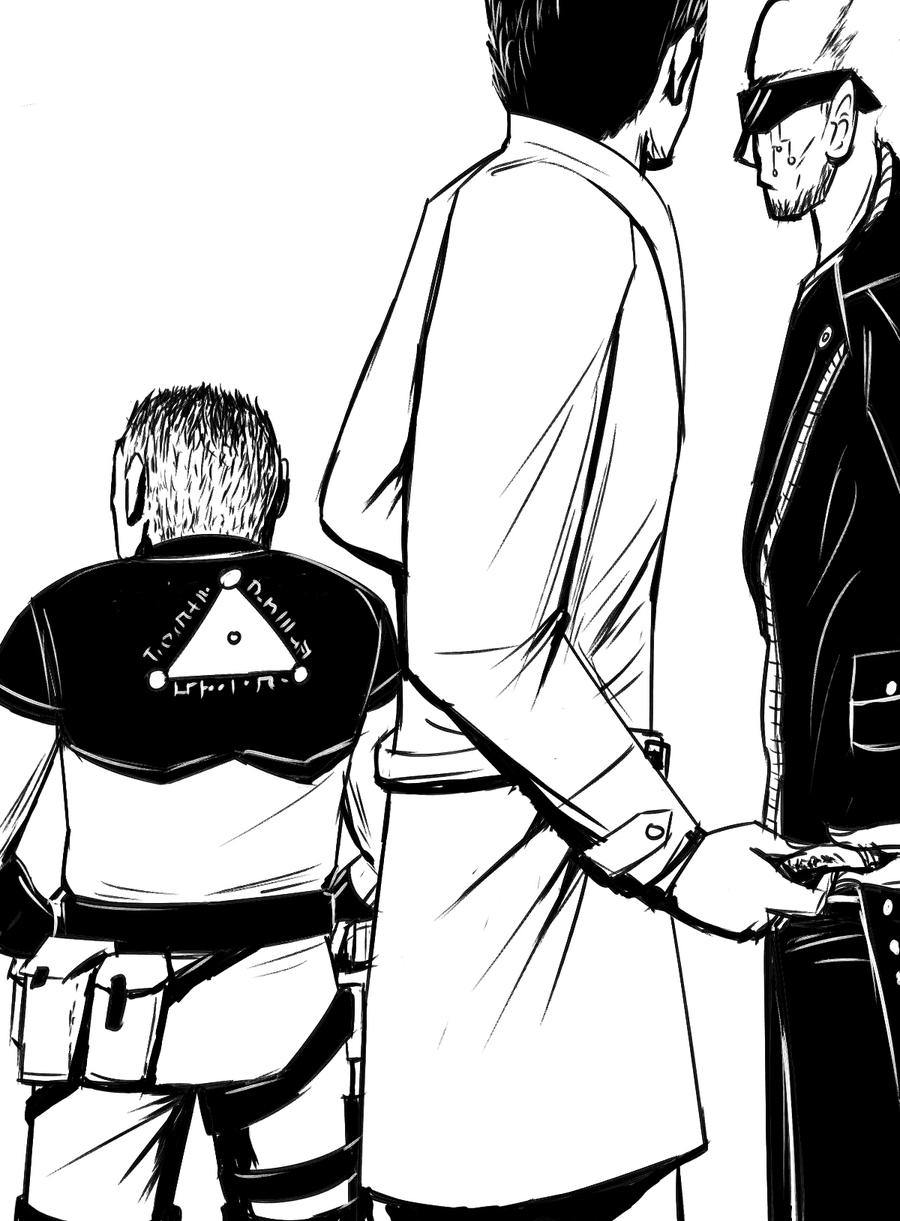
In some cases, items may be illegal. The legality of items varies from world to world and even from region to region within the same world, so there are usually only general notes for what kinds of items are considered legal or illegal in any given area. If there are no explicit notes on the legality of a given item, the GM should determine the item's legality. Any item which is illegal should be considered to have a Rarity Rating 2 points higher than what is listed, and successfully acquiring such an item may incur problems with the authorities if a glitch is rolled on the Rarity test. Additionally, the authorities may come looking for contraband, providing new stories, conflicts, and obstacles.
Space Manufacturing
Not all Cultures in Afterverse are capable of manufacturing objects in space. In general, MFR TL 6 (see Tech Levels, below) is required for a Culture to be able to manufacture items in space from the resources amply found in orbit (such as metals mined from asteroids). Even when the Culture's technology allows it, it might not be possible; many materials are not readily available in space (such as plastic, which is manufactured from either fossil fuels or plant life, neither of which are abundant off world), requiring these materials be shipped up from a planet's surface.
If an item is needed in orbit or on a planet that does not have space manufacturing capabilities, and it cannot be manufactured there for any of these reasons, then that item is worth drastically more money than it otherwise might be. In general, multiply the Cost of such an item by 100; this may be adjusted by the GM downward for items that are lightweight but expensive. If the Culture has fusion ion propulsion available (PRP 7), then this "shipping cost" is mitigated, and the item Costs only 10 times as much as its standard Cost. If the Culture can use a propulsion-free system like a space elevator or orbital ring, then there is no Cost increase—but then, at that MFR TL, manufacturing in space is no problem in any case.
Tech Levels
Every Culture has a table of Tech Levels (TLs) associated with it. There are seven categories of technology, and each has associated with it certain kinds of gear and expertise. The kinds of items available to a particular Culture are determined by the TL; the TL of a Culture in the appropriate category must be equal or greater than the TL of the item.
Tech Levels range from 0 (no technology whatsoever) to 12 (the best in the galaxy). This level represents not specifically the level of technology that is possible, but more importantly the level of technology that is widely available. If some technology is developed but not adopted by the public, the TL in that area will represent a lower score. For example, on Earth in the early 22nd century, genetic engineering tech is possible, but not considered ethical by the public, and is thus hard to find. In these cases, the rules for Cutting Edge technology still apply as normal (see below).
Some gear changes functionality depending on the Tech Level, gaining new abilities (usually with no downside) when the item comes from a higher TL Culture. These changes will be described in the item's description.
Manufacturing (MFR)
Materials sciences and construction. Used in creating structures, fab labs, and armor. At very high levels, it can create teleporters and replication technology.
Medical (MED)
Healing as well as enhancing, whether by cybernetics, replacement organs, or genetic enhancement.
Computers (CPU)
Besides the obvious, the Computers category also governs the effectiveness of sensors and communications.
Weaponry (WEP)
From swords and axes to guns, then all the way up to guided missiles, weaponized lasers, and beyond.
Power (PWR)
Power generation, usage, and storage.
Propulsion (PRP)
From the wheel, to the car, to balloons and planes, then to rockets and beyond.
Physics (PHY)
A general understanding of the way the universe is put together. Fields of technology such as relativity and gravitics are dependent on this TL.
Cutting Edge Equipment
It is sometimes possible (with GM approval) to obtain gear one TL above what would normally be available. If it is available at all, the item Cost should be multiplied by 10 and the Rarity should be increased by 6 points. Such equipment often has a story behind its acquisition, and may serve as plot hooks. It will also be highly desirable to others, who may try and steal or con it away from the character. Using Cutting Edge gear is always subject to GR +1, with a glitch representing some imperfection or failure with the gear. If the Cutting Edge gear is used outside its intended parameters (e.g. if it was built for a single planet or has missed its recommended maintenance), the GM may choose to raise this to GR +2.
When such gear is acquired, any Attribute of the item that is dependent on a TL treats the TL as if it were the value being simulated. For example, if acquiring a Cutting Edge First Aid Kit, its Rating may be the Culture's MED TL + 1.
Tech Level Specializations
Some Cultures have a particular expertise in subsections of some Tech Levels. In these cases, the Culture can always manufacture gear of the type the Specialization describes, regardless of the required TL that is listed with the item. When the exact number of that TL is needed, that Culture's effective TL is increased by 2 for items within that Specialization.
Common Technologies
Some technology has multiple uses across many different kinds of gear. Rather than describe the technology for every single piece of gear that uses it, it is described here.
Shape Memory Polymers
A shape memory polymer is a firm, gel-like substance that, when affected by an electrical current, hardens into a particular, predetermined shape. This is especially useful for items used in combat—a nonlethal weapon can instantaneously gain a sharp edge, and armor can be soft and unencumbering (as well as hidden from weapons scanners) until the instant it's needed.
Metamaterials
Metamaterials are a kind of material constructed at a nanometer scale to grant properties that no straightforward compound or element could possibly have. They are designed chemically, usually for a specific purpose, and are often manufactured using nanomachines.
Vacgel
The skysteads on Venus (see Tech and Gear) are constructed of a metamaterial called Vacgel which creates a lattice of sulfur and carbon molecules (among others). Each microscopic bubble of Vacgel contains a tiny volume of vacuum, making the substance as a whole lighter than the dense air of Venus, enabling it to float in the air. Vacgel can be designed for some other elements, but carbon and sulfer were chosen because they could be gathered in place from Venus's atmosphere.
Hyperadhesive Polymers
A kind of metamaterial, a hyperadhesive polymer (often called HyPoly, despite the objections of the HyPoly manufacturer, who would prefer its brand name not be used to describe its competitors as well) reacts to contact with certain types of atoms (chosen when the polymer is designed) by physically bonding. The bond is so strong that it effectively becomes one with whatever it is bonded to; removing the polymer usually involves removing a surface layer of whatever it's attached to. For this reason, any HyPoly that may adhere to skin, scales, or other living matter is considered a biohazard and is often illegal. HyPoly cannot be made to adhere to smooth or polished metal, though rough metal (such as cast iron, metal ore, etc.) may work.
Lemurian Technologies
The planet Lemuria (see Tech and Gear) was charted during the Artifact era (see age XX) and plays host to a plethora of ancient, high-technology artifacts, well beyond the technological capabilities of the extant civilizations of the Orion Arm. After some study of the artifacts found on Lemuria, it's clear the Junardms (created by an artifact found on Bactara) come from the same civilization. Given their technology and apparent pervasiveness, the Lemurians are widely suspected to be the species that built the Orion Arm Warp Bridge Network. If nothing else, they were definitely major users of the network.
Junardm: Bridge Traversal Devices
This device, introduced to the galaxy courtesy of the Lemurian Ancients, is the device which allows a vessel to traverse a warp bridge rather than simply falling into the singularity and being crushed. A Junardm is a lens-shaped metallic object roughly 100 meters across. While no extant civilization has yet been able to reverse engineer one, the Bactarans found a device on their home world which was capable of reproducing them. With ingenuity, plus some trial and error (and many lives lost), the Bactarans were able to work out how they are used, and became the first modern civilization to use the warp bridges. They have traded the Junardms they manufacture to Humans and Vorans in exchange for mining rights, political favors, territory in various systems, and other compromises.
The Junardm is activated by following a direct collision course with the singularity on your side of the warp bridge, with the angle of approach within a few degrees of the orbital axis of the bridge's stabilizing ring. Just before the event horizon is contacted, the Junardm forms a "bubble" on the opposite side. Anything within this bubble is transferred through the warp bridge, and emerges on the other side, with the Junardm's front side facing the receding singularity on the other side of the bridge.
ITG
Interversal Transfer Gates, or ITGs, are disc-shaped devices that serve as teleportation portals. The ITG's flat, active surface disintegrates and transports atoms as they contact it, and does the inverse when the matter exits on the connected Gate. It also accurately transmits force, energy, and light through the gate. The range of these devices is limited to about 300 kilometers. The ITG has no "bezel," and the edge can function as an incredibly sharp knife, slicing and transmitting only one part of an object; most of them, however, are built into a wall or surface that prevents this situation for safety reasons. Similarly, if an ITG is shut off while someone or something is moving through it, the object can be sliced cleanly and instantly in half. Although ITGs have backup power supplies to minimize the chances of this happening, it is not unheard of. This problem is known as "gate-slicing."
It is possible to use a pair of them to reach low orbit, with some caveats. The orbiting ITG will likely only be within range for a minute or less during each orbit. When it cuts off, the danger of gate-slicing can be an issue. Secondly, to compensate for the change in velocity, huge amounts of power must be pumped into the receiving gate. Failure to do so will cause unpredictable problems manifesting, perhaps as burns, random "slices" of matter, or sometimes a drain of all energy. These issues occur randomly as the object passes through, and thus the issues affect only one "cross section" of matter that is crossing the gate at a time. A person going through such a process will receive 3 or 4 such wounds; they will cause infirmity, lacerations, and brain damage—they are almost always fatal.
Drugs, Toxins, Poisons, and Chemicals
(For a list of substances and their effects, see the online edition.)
Certain substances have specific effects on various life forms. Each life form has its own reaction to these substances, so when determining this effect, the Substance Effects table must be consulted. Each cell in the table has 4 values: the dosage (in grams, milliliters, or ppm), the Standard Effect, the Overdose Effect, and the Addiction factor.
When a character comes into contact with the substance, the first thing to determine is how much. The physical amount must be converted into a dose multiplier. The math is straightforward—simply divide the amount by the dosage to get the multiplier. Put this value into a Substance Effect Bank.
The character then rolls BOD to reduce this bank (including to resist effects that may be desired); take into account any effect from Qualities such as Immunity to Poison or Drug Tolerance. The result of this roll is subtracted from the Substance Effect Bank. If the resulting value is 0, then the drug has no effect. Otherwise, proceed to the Standard Effects step.
The Cost of the substance listed in the table is the Cost for the highlighted dosage in the table. The Costs for other dosages should be estimated accordingly.
Standard Effects
If there is at least one point in the Substance Effect Bank, the Standard Effect of the substance triggers once. Use the Standard Effects cell for the character's species, and refer to the Effect Descriptions section below to interpret the effect.
Overdose Effects
Overdose Effects are more severe effect that happen at a certain dosage, listed in the effect box. Once this level is reached, every point in the Substance Effect Bank at or above this dosage level triggers the effect described in the cell. For example, if the Substance Effect Bank has 6 points, and the Overdose Effect cell reads 3: 2P, the character will receive 2P unresisted a total of four times.
Effect Descriptions
Attribute Effect
+/- (x) ATT
The specified Attribute is modified for the duration of the drug's effect. If this modification surpasses the standard species maximum for that Attribute, the modified value is valid, but the character takes 1 unresisted Physical Damage when the drug is taken as well as once each time they attempt an Action involving that Attribute. (This does not apply if the character has the Freakish Quality applicable to that Attribute.) If this modification brings the character below 0 in that Attribute, the character immediately enters the Bleeding Out state, going catatonic and requiring medical attention.
Physical Damage
(x)P
The character suffers (x) Physical Damage, unresisted. This damage can overflow and cause the character to enter the Bleeding Out state like other Physical Damage.
Stun Damage
(x)S
The character suffers (x) Stun Damage, unresisted. This damage can overflow into Physical Damage like other Stun Damage.
Hallucinations
H
The character senses (sees, hears, smells, and feels) things that do not exist. All Actions this character takes are subject to a +(2 × bank) Glitch Risk for most tests, or +(4 × bank) GR for Perception tests; a glitch indicates the Hallucinations have interfered with the Action. (If a glitch is not rolled, the character is still Hallucinating, they just haven't interfered.)
Vomiting
V
The character is forced to throw up, and won't be able to keep any food down. If this state persists, the GM should treat the character as if they're starving.
Euphoria
E
The character experiences a chemical high, with pleasure centers in the brain being directly stimulated. The character gains one point to his Chutzpah Bank, but Chutzpah may not be used for any of the die rolls relating to this drug, such as the Addiction test.
Seizures
Z
The character loses physical control of the body and displays a jerking movement as a result of muscle nerves firing at random.
Pain Relief
(x)Pn
The character may reduce the Glitch Risk effects resulting from either Stun or Physical Damage by (x).
Effect Timing
All substances' effects are assumed to have certain timings based on their vector unless otherwise noted in the description. All substances that are injected take effect one full combat turn after injection, immediately before that character acts on their next turn, and wear off after approximately one hour. Substances that are inhaled take effect after one minute, and also wear off in one hour. Substances that are ingested generally take over an hour to take effect, and last about a day.
Addiction
Addictive drugs have an Addiction factor that varies per species; if this value is 0 or blank, ignore this step. There are two aspects to Addiction: getting addicted, and being tempted by the addiction.
Gaining an Addiction uses the following rules. After the effect of the drug is handled, multiply the Substance Effect Bank's value by the drug's Addiction factor. If the character has the Drug Recovery Quality, add its level to the bank's value. Next, the player rolls WIL, and reduces the remaining Substance Effect Bank by the result. If the character already has the Drug Tolerance Quality for this drug, subtract the level of that Quality from the bank. If any points in the bank remain, add one level to the Drug Tolerance Quality for this drug, and clear the bank.
Addicted characters will occasionally, at the GM's discretion, be tempted by the drug. This process should happen periodically for any character with the Drug Tolerance Quality who has not used the drug lately (more often for higher levels; possibly daily). For characters with either the Drug Tolerance or Drug Recovery Quality, a temptation may be triggered any time they come across a situation where they may be reminded of the benefits of the drug. For example, at emotional low points for any drug with the Euphoria Effect, or if put into a situation demanding high reaction times for a drug that positively affects that Attribute.
To resolve a temptation, first set the value of a bank to the drug's Addiction factor, rounded up; multiply this bank by the level of the Drug Tolerance Quality plus half the level of the Drug Recovery, rounded up. The character may resist the temptation by rolling WIL, with each hit reducing the bank by 1. Other characters may roll MAN + Influence (Persuasion) or INT + Medicine (Pharmocology) with the same effect if they are aware this may be happening. If any points remain in the bank, the character will enter withdrawal, and lose this number of points from their XP bank (which may go negative in this case) if they do not fulfill the Addiction. If this happens, one level of the Drug Tolerance Quality is removed, and replaced with a level of the Drug Recovery Quality. If the character does satisfy the Addiction instead by using the drug again, then this bank is cleared.
Medical Care and Treatment
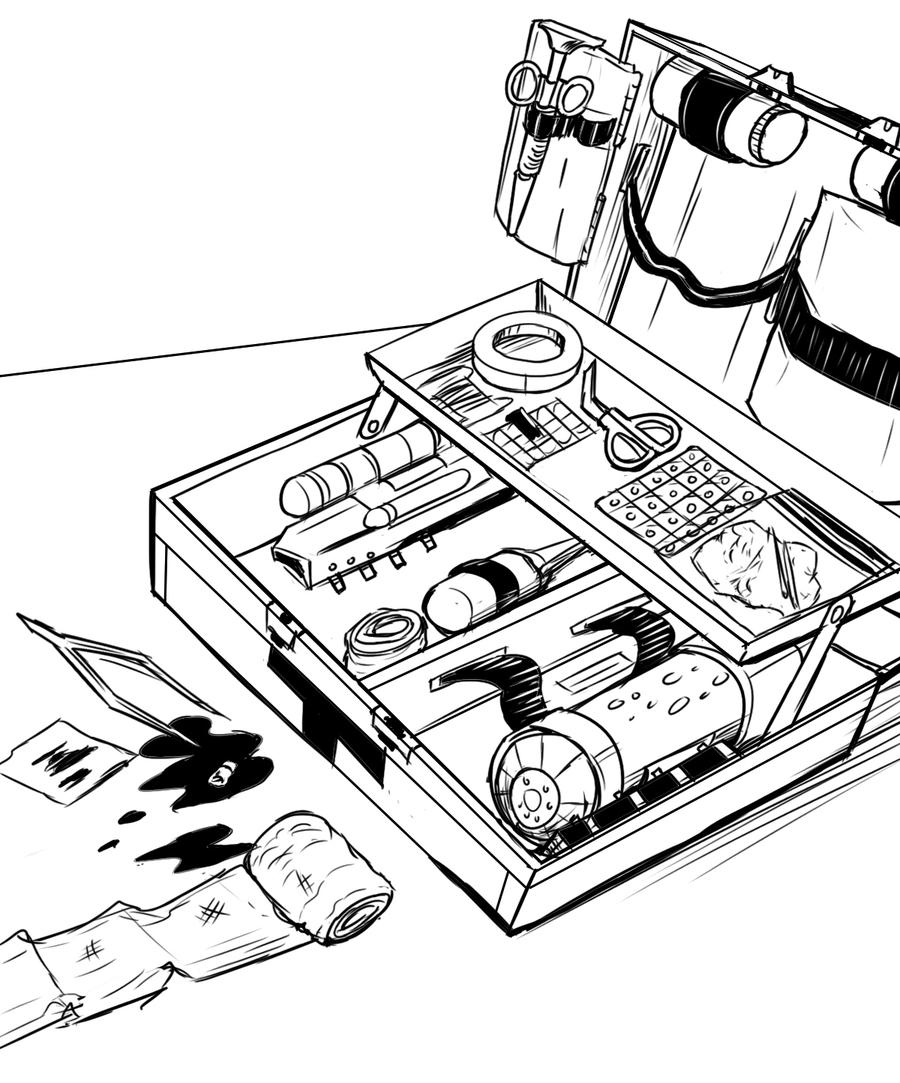
Medical care can assist in the use and treatment of drugs and substances in a few ways. First, when the dose of the substance is applied, the doctor may roll INT + Medicine (Pharmacology) for drugs, or INT + Medicine (Toxicology) for toxins and poisons, and bank these hits. This bank may be spent at any point in the patient's use of this drug to reduce the patient's Substance Effect Bank, which may prevent Overdose and/or the development of Addiction. If the doctor is themself the drug user, the maximum value of this bank is their WIL.
During withdrawal, the doctor may roll INT + Medicine (Pharmacology) and bank the hits; these hits may be added to the user's relapse test result. The Medicine Skill is not strictly necessary here. One may use MAN + Influence (Persuasion) normally, as well.
One particular form of help that has a special effect is restraint. If the user is physically unable to use the drug he is addicted to— locked in a room, restrained to a bed, etc.—then the relapse test is automatically passed at that time. However, once this restraint is removed, the user must make the relapse test at that point. When making this test, the user gets +1 die for each day they were restrained.
Cybernetics
(For a list of all available cybernetic modifications, see the online edition.)
Cybernetics are machines designed to integrate with and augment a biological body. Cybernetics can give you abilities not available to others, but it's not all roses and explosions. Choosing to augment your own body is a serious decision with serious consequences.
Disruption
Every piece of cybernetics has a Disruption score, usually fractional. The main effect this has is on medical treatment, which is made more difficult by the presence of foreign objects in the system. Any time a character with cybernetics is treated medically, the Glitch Risk of that test is increased by the total Disruption score of all cybernetics (rounded up). If the doctor is unaware of these cybernetics (for example, if the patient is unconscious and cannot tell him about it) then their effective Disruption for this test is doubled, after rounding up. Additionally, a character with cybernetics takes the same effects as the Immunocompromised negative Quality, at the same level, Disruption rounded up.
Any detection test relying on life signs (such as heat) may have a hard time finding a heavily augmented character if the character is among other machinery or in an artificially constructed environment. The threshold for such a test will be increased by the Disruption score of the character, rounded down. Conversely, machine parts may make a character stand out in a natural, life-filled environment such as a forest. The threshold for such a test is reduced by the Disruption score, to a minimum of 1.
Genetic Engineering
(For a list of available genetic modifications, see the online edition. Also see the "Genetically Modified" Quality on the online edition.)
A character may be genetically modified, granting new abilities or different Attributes on a biological level. There are two methods this is accomplished—modifying a fetus in the womb, or retroviral engineering later in life.
Engineered from Birth
A character that was genetically modified in utero—or if any of her direct ancestors were, regardless of whether those modifications were inherited—the character must take the Genetically Modified Quality. When she does so, she may then spend a certain amount of XP depending on the Culture's MED TL on Genetic Qualities (calculated using (MED TL - 3) × 10), which are not counted against the XP limit for Qualities. Note that the relevant MED TL is the level of the Culture available at the time of conception/birth, not the level at character creation or puberty.
Retroviral Engineering
At higher MED Tech Levels, it is possible to use an engineered retrovirus to make some modifications to the body after birth. This is much more complex than engineering from birth. First, a retrovirus is created which self-replicates throughout the body and adjusts the DNA in the cells as it goes. But simply changing genes does not instantly rewrite the entire biology of the creature. Forcing changes often involves destroying the old part of the body and allowing the new part to regrow as an intensive treatment regimen.
Retroviral engineered changes requires 1 MED Tech Level higher than they would if the changes were engineered from birth. Not all Genetic Qualities are available at all as a retroviral treatment; it is only available if a retroviral cost is listed in the Quality's entry on the table.